Author: Steve Sabean

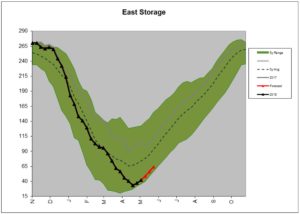
  • Canadian East Storage as of May 4, 2018

    As of Friday, May 4, 2018, Canadian east storage level was 42 Bcf. This represents a net increase of 5 Bcf from the previous week. Stocks were 61 Bcf less than 2016/17 at this time, 90 Bcf less than 2015/16 and 31 Bcf below the five-year average of 73 Bcf. Total gas in storage is at the low end of the five-year historical range.

    Canadian east natural gas inventories are now 42 Bcf

    Last year:  103 Bcf

    5-year average:  73 Bcf


    For more information on Dawn storage: link


  • A Stormy Summer For Ontario

    Last Friday, May 4th, Ontario experienced tornado strength winds that saw many homes lose roof shingles, large trees and power. Our home in the country was without power from the utility for 24 hours. Fortunately, we have a standby natural gas generator for such occasions. We weren’t the only ones as I could hear 5-6 other generators in the neighbourhood.

    This may not be the end of severe weather for 2018. Accuweather is forecasting a stormy summer across Ontario and southern Quebec. “There is a higher risk for severe thunderstorms and tornadoes this summer over Ontario and southern Quebec” – Accuweather Canada Weather Expert Brett Anderson.

    With each passing year, more unusual weather appears. This summer we could see thunderstorms and tornadoes bring damaging winds, hail and flash flooding. It’s good to be prepared.

    For more 2018 weather predictions across Canada:

    https://www.accuweather.com/en/weather-news/2018-canada-summer-forecast-severe-storms-to-eye-ontario-fire-danger-to-grip-prairies-british-columbia/70004869


  • Ontario Energy Rebates And Incentive Programs

    Take advantage of Ontario programs and rebates to reduce your energy costs and fight climate change. The Green Ontario Fund is a not-for-profit agency of the Government of Ontario and funded through proceeds from Ontario’s carbon market. On their website are links to many residential and business rebate programs.

    For example the SMART Green Program provides financial incentives for small- and medium-sized manufacturers up to $500,000 per facility or $1,500,000 for multi-facility organizations to implement equipment, technology and process improvements. Businesses can also receive up to $150,000 to hire an energy manager. This program if offered through SaveOnEnergy.

    https://www.greenon.ca/


  • Energy Conservation Report volume one

    The Environmental Commissioner of Ontario is an independent officer of the Legislature (non-partisan) who reports on government progress on environmental protection, climate change and energy conservation. The ECO is the province’s environmental watchdog and guardian of Ontarians’ environmental rights. On April 10, 2018, ECO published Energy Conservation Report volume one. The second volume will be published later in 2018.

    Volume one answers 19 questions about electricity in Ontario. In addition to the impact on the electricity system, prices and the environment, the report comments on Ontario’s electricity future. Ontario needs more clean electricity and conservation to replace natural gas, gasoline and diesel. But Ontario in slow in transition. Some of the ECO recommendations include:

    1. Ontario’s Long-Term Energy Plan (2017) should be consistent with other government initiatives.
    2. Conservation should play a larger role.
    3. Ontario should make better use of flexible tools such as storage and demand response.

    Link to Environmental Commissioner Of Ontario https://eco.on.ca/our-reports/energy/

    The full report: http://docs.assets.eco.on.ca/reports/energy/2018/Making-Connections.pdf

  • 100-Year Transportation Contracts Available

    100-Year Transportation Contracts Available

    As soon as the natural gas market starts to make sense, more craziness occurs in the pipeline side of the market. Early this year TransCanada Pipelines (TCPL) completed transportation contracts of over 100 years in length.

    Earlier this year I wrote about the way natural gas transportation is allocated across Canada, <<TransCanada Rules>>. The recent long-term transportation contracts show one result of the new process. Direct contracts with TCPL are regulated by the National Energy Board, so the only differentiator in the bidding process is term. Where natural gas shippers could in the past contract for one year at a time, now shippers need to include a 100 year term with their bid to acquire necessary transportation.

    In the secondary market the cap is off and transportation rates are rising.

    Producers are doing all they can to get their gas supply production out of Alberta to avoid the low commodity price at Aeco. With continuing constraints at Empress, Alberta, shippers currently place a very high value on having firm transportation to Ontario and Quebec.

    The length of the transportation contracts also shows the sentiment in the market on the likelihood (or unlikelihood) that LNG ports will appear on Canada’s west coast.

    TCPL has committed to expanding transportation infrastructure to alleviate some of the choke points but pipelines need planning, approvals and time to build. <<Changing Dynamics >>

    Aeco, Alberta prices have improved somewhat but are expected to stay low this summer. All other delivery points (Empress, Dawn, etc) are close to where they should be in comparison to traditional supply and demand.

    For more information: Link

  • Natural Gas Storage Levels Update

    Natural Gas Storage Levels Update

    The highest peak of natural gas demand occurs during the heating season from November to March. Then on the 1st of April each year, storage facilities switch from net withdrawals to net injections.

    Due to the latest nor’easter in March that moved through the American Northeast and Atlantic Canada, US storage withdrawals continue to be weak.

    This year’s storage ending balance is expected to be at 1.3 trillion cubic feet (tcf) compared to the five-year average end of season balance of 1.71 tcf.

    In Ontario, the natural gas storage level at Ontario’s Dawn Hub is also near its lows for this time of year. Meanwhile out west, AECO storage levels in Alberta remain near record highs, a sign of continuing export challenges.

    The outcome is that record high production levels are expected to keep a lid on prices. On the flip side, expectations of significantly diminished end-of-withdrawal-season stocks are feeding bullish sentiment.

  • Winter Storm Toby the Latest Nor’easter

    The fourth nor’easter in less than three weeks slammed the Atlantic Northeast last week, with up to 35 centimetres of snow landing in parts of the US on Wednesday and Thursday. Toby then pushed northward into the Maritimes, Newfoundland, eastern Quebec and southern Labrador.

    Three storms have ripped across the Northeast this month, with more than two million customers without power during the worst of them, which also caused high seas and flooding along the Atlantic coast from Massachusetts to New Jersey. A nor’easter is defined as a strong area of low pressure along the east coast, featuring winds from the northeast off the Atlantic Ocean.

    Meanwhile in the west, cold artic air settled over portions of Alberta and B.C. on Thursday and Friday with up to 40 centimetres of snow.

    So far this spring, the cold and snow appear to be missing Ontario.

  • The Changing Dynamics of Canadian Natural Gas Supply

    TD Securities recently published an excellent summary of why Alberta gas prices have weakened so much and why we can expect them to remain low until 2021.

    Beginning in the second half of 2017, Alberta natural gas prices began to plummet and to show incredible volatility.

    Alberta’s decreased natural gas prices can be primarily attributed to three factors:

    1. Interruptions on the intra-Alberta Pipeline System

    Extensive maintenance disruptions and weather-related issues have affected the flow of natural gas from well-head to outlet stations and to underground storage. This is expected to be a recurring problem until more compression is added at the eastern Alberta border. On February 15, TransCanada PipeLines Limited (TPCL) announced the intra-Alberta pipeline system will continue its expansion project in southern Alberta at Empress along the Saskatchewan border. The expansion, already partially in service, would be completed by April 2021. These disruptions are occurring simultaneously as production is increasing in Alberta.

    1. Growing Canadian Domestic Supply

    New supply basins as well as new technologies have resulted in increased production at lower costs. Although the production is increasing, the pipeline infrastructure to deliver the gas supply to traditional destinations is not available. Additionally, western Canada storage levels remain abnormally high despite this year’s early cold winter.

    1. Decreased US Demand as its Natural Gas Supply Increases

    Traditionally, the US has imported much of Alberta’s natural gas supply production; however, the US has experienced a prolific growth of its own in the order of a 56% increase in the last 10 years. 60% of this expansion in natural gas production is destined for use in industrial and electric power plants while 40% represents exports to Mexico, Canada and Liquified Natural Gas (LNG) shipments.

    Alberta Prices Expected to Stay below $2 Until 2021

    Currently, there is a negative sentiment surrounding Alberta natural gas prices. In TPCL’s most recent update to their Daily Operating Plan, they added new outage events for this summer. This could put further downward pressure on prices.

    However, like any commodity market, there are a several influences that could create natural gas price increases as early as Q4 2018 or Q1 2019. These include the following:

    1. Production Response

    Many producers hedged at higher prices. However, those who didn’t may decide to cut production. Also, hedges will run out, and if Alberta prices continue to be weak, more producers will shut in production. Producers typically don’t want to shut in production as there are many other factors that motivate producers to continue, even if simple economics show the cost to produce is less than the sale price. Therefore, it is unlikely Alberta gas production will decline this summer.

    1. Planned Pipeline Expansions

    There are many new pipelines surrounding Alberta that are designed or are in the planning stages. If all or most are constructed, natural gas flow will not experience the same amount of interruption to their destinations.

    1. Growing intra-Alberta Gas Demand

    Alberta is reducing its coal consumption and replacing it with natural gas. Natural gas usage for oil sands projects continues to increase.

    1. Further Demand Growth from North American LNG projects

    Liquified Natural Gas (LNG) is operational at various sites in the US and more are planned there as well as in Canada. Alberta wants to build an LNG terminal on the west coast of British Columbia but is experiencing opposition.

    Beyond Alberta

    From a consumer perspective, it is good to see that natural gas prices are low and expected to stay that way in the foreseeable future. However for natural gas transported to companies in Ontario and Quebec, the Alberta price is only part of the story. Natural gas needs to get out of Alberta and into Ontario. A different set of dynamics affect these transportation components. For instance, the cost to move gas out of Alberta and onto the TCPL was around 0.25/GJ. With interruptions occurring and with TCPL changing their toll methodology, the result has been a huge price increase in the secondary market.

    The relationship between natural gas, the Nova Gas Transmission Ltd. (NGTL) systems’ intra-Alberta transportation and TCPL long-haul transportation has changed dramatically and created huge volatility. On the downstream side of the TCPL pipeline, Dawn Hub storage inventory levels continue to draw down significantly faster this season than last. Inventories could fall to levels far below the previous five-year average. However, filling storage should be easier than past years with access to cheap supply from Alberta and the US.

    Alberta gas is becoming less significant in the overall North American natural gas market. Ontario stands to benefit as its natural gas supply sources become more diversified. Despite the changing dynamics of the gas supply commodity and natural gas transportation from Alberta to Ontario, the fully delivered natural gas price into Ontario has remained relatively stable and priced significantly lower compared to US prices.

    Opportunities exist to take advantage of the dynamic North American natural gas market.
  • Industrial Conservation Initiative, Global Adjustment and Class A

    Ontario customers participating in the Industrial Conservation Initiative (ICI) pay a Global Adjustment (GA) based on their percentage contribution to the top five peak hours of energy usage over a 12-month base period from May 1 to April 30. Those who partake are referred to as Class A consumers.

    To anticipate when these peak hours are most likely to occur, the Independent Electricity System Operator (IESO) lists the following factors:

    Time of Year

    Weather is the main variable driving electricity demand in Ontario. Energy usage in the province typically peaks in the summer, during hot humid days and heat waves. Demand also spikes during extreme cold snaps in the winter.

    Time of Day and Days of the Week

    Historically, demand peaks occur during the week when businesses are open. Time-of-day demand varies between seasons. Winter peaks are inclined to be early in the evening when people turn on lights on and cook dinner. On the other hand, demand in summer tends to be higher in the early- to mid-afternoon when air conditioners are powered up during the hottest time of the day.

    Tools to Assist Class A Customers

    The IESO’s website allows you to see the top ten real-time demand peaks and forecast data for the hours and days ahead in order to track peaks.

    Adequacy Reports publishes Ontario’s hourly electricity requirements for today and for the next 34 days. These are updated throughout the day as conditions change.

    Power Data. This allows you to follow current and projected electricity demand in real time.

    In the current 12-month base period (May 1, 2017 to April 30, 2018) the top five energy hours so far occurred in June, July, September (twice) and January. The probability of incurring one of the highest peaks in March of this year (or April) is low. When looking at the weather outlook for the month of March we are getting some conflicting reports about temperatures. Some networks are saying the temperatures will be in the normal range while the other network is saying they will be below normal range. Both agree that precipitation will be higher than normal with expected snow falls throughout the month.

    The overall total January GA was down to $786 million from its usual $1 billion. There is an inverse relationship between Hourly Ontario Energy Price (HOEP) and GA costs. As the HOEP rises, total GA costs go down and vice versa. Due to the high HOEP in January of $31.14/MWh, the GA was $67.36/MWh. Total GA of about $1 billion per month is expected for the rest of the calendar year.

    Now is the time to consider Class A. The due date to select it is June 15, 2018.

  • Hydro One Sale Means Increased Long-term Electricity Costs for Ontario

    Hydro One went public in November 2015 and as of December 2017, Ontario owned 47% of the utility.

    The Financial Accountability Office (FAO) has examined the sale and concluded that $1.8 billion would have been saved if the Ontario government had taken on debt instead of partial privatization.

    Although Ontario realized a profit of $3.8 billion in the first three years, the  province’s debt will increase in future years because of one-time charges and fewer dividends. “This was short-term gain for very long term pain. This is not good for Ontarians,” said PC finance critic Lisa MacLeod.

    Hydro One rates continue to be regulated by the Ontario Energy Board.

    For more details, click here.